

AR vs VR vs Interactive Displays: Which Fits Your Brand Activation?
AR vs VR vs Interactive Displays: Which Fits Your Brand Activation?
Quick Overview: AR vs VR vs Interactive Displays
Augmented Reality: Overlaying the Real World
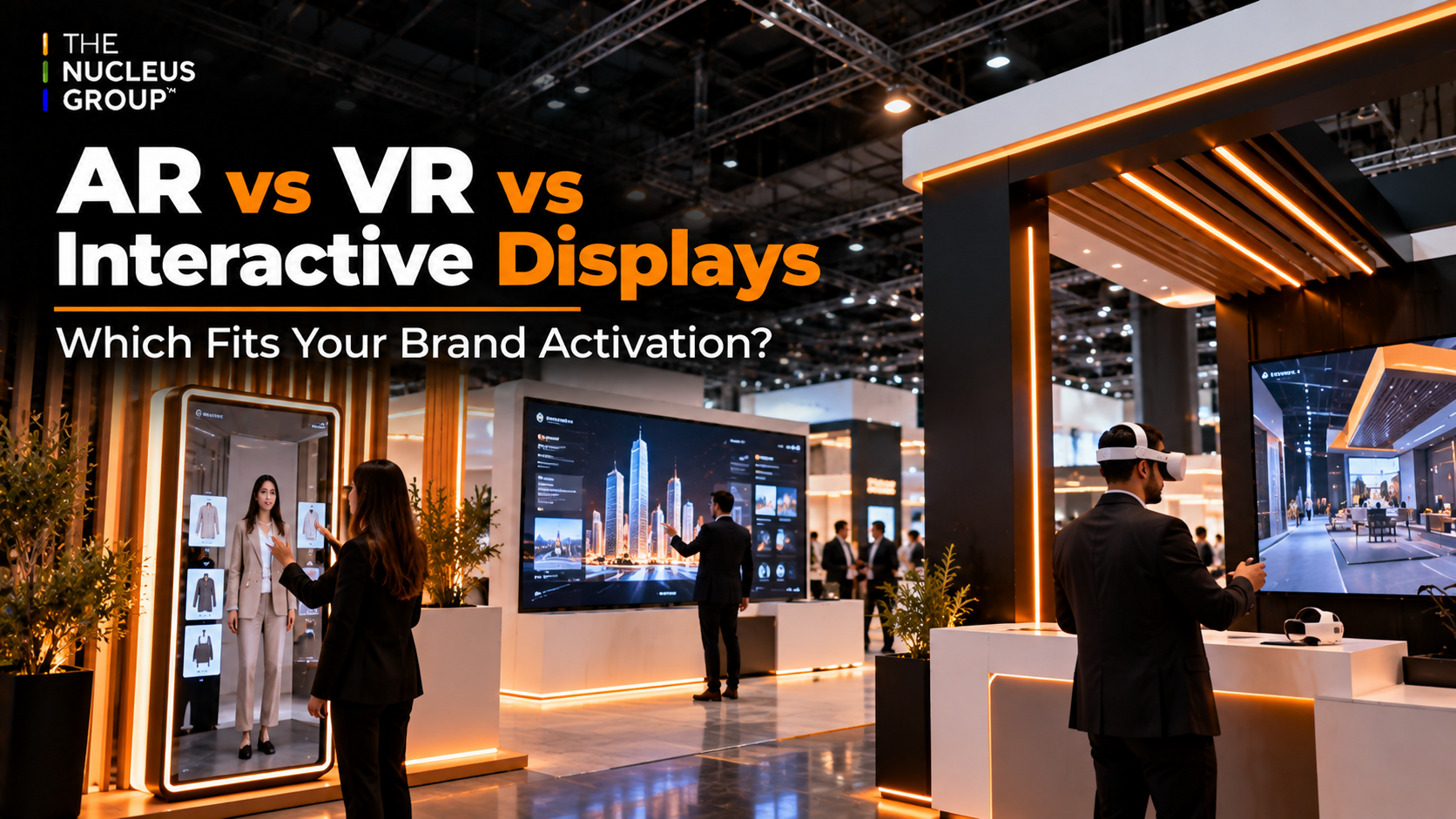
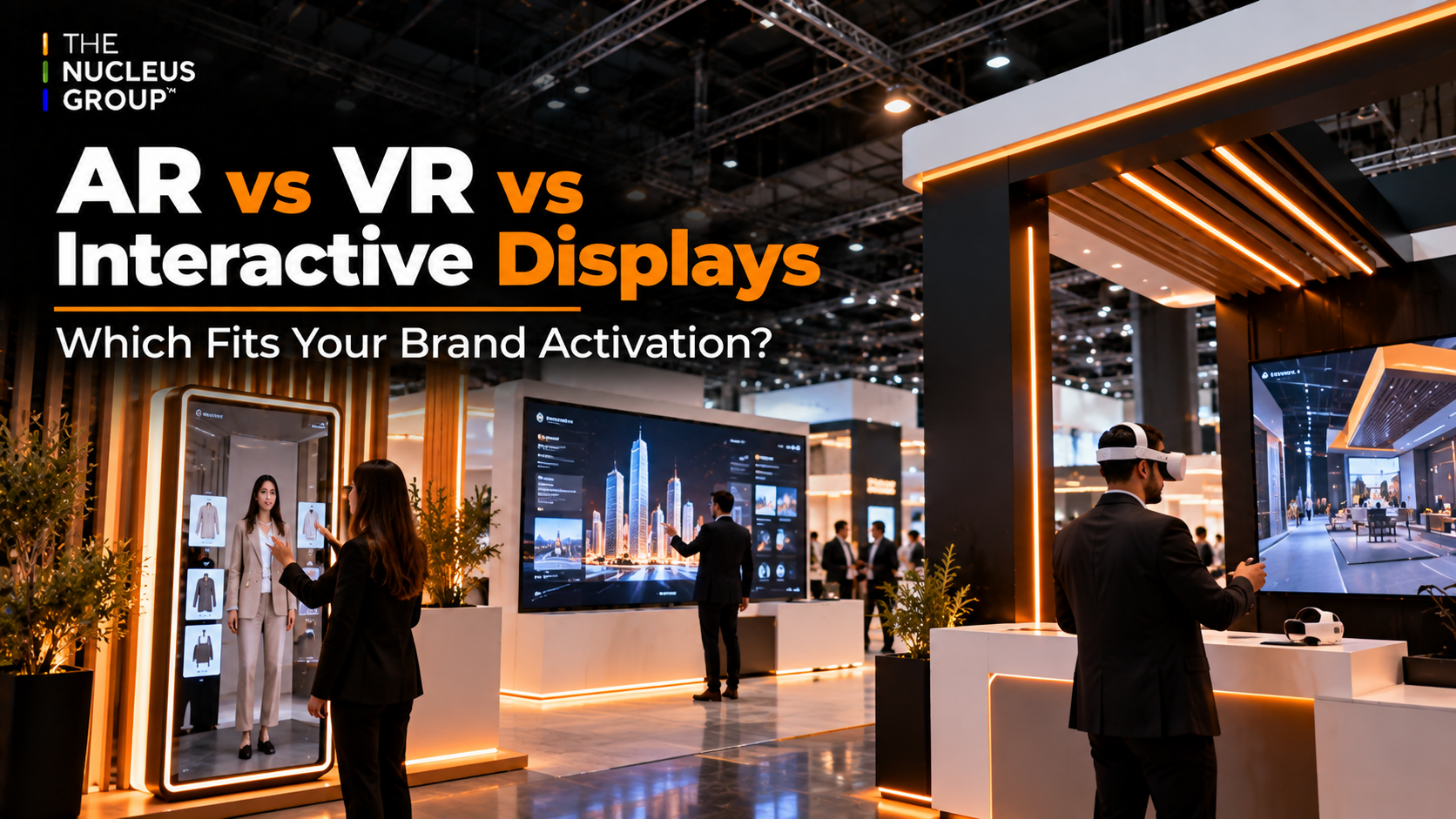
AR overlays digital content onto the physical world through a phone, tablet or AR mirror, without needing a headset. On a booth floor, that means a visitor can point a device at a product and see it in a different colour, scan a wall to trigger an animation, or see a virtual version of an item on themselves in real time. Because there's no headset to fit and no isolation from the surrounding environment, AR handles high foot traffic well; a visitor can engage for thirty seconds and move on, which matters at a busy trade show where dwell time is limited. Nucleus builds AR experiences including scavenger hunts and driving simulations designed around exactly this kind of quick, walk up engagement.
Virtual Reality: Full Immersion, One Visitor at a Time
VR replaces the visitor's field of view entirely through a headset, creating full immersion in a simulated environment. This is the strongest tool for storytelling and emotional impact, a VR retail pod can place a visitor inside a product environment that would be impossible to build physically on a show floor. The tradeoff is throughput: only one or two people can experience a VR station at a time, headsets need cleaning between uses, and the format asks more of a visitor than a brief AR interaction. VR works best when depth of impression on fewer visitors matters more than reaching everyone who walks past. It suits a high impact, lower throughput moment rather than a high traffic one. Nucleus's AI technology division builds immersive VR experiences for exactly this kind of activation.
Interactive Displays: The Accessible Middle Ground
Interactive displays cover touch screen walls, interactive screens and 3D holograms, formats that need no headset, no app download and no instructions beyond touching the screen. This makes them the most accessible of the three: any visitor, at any comfort level with technology, can engage immediately. They're strong for data storytelling, wayfinding, and product catalogues where the content itself is the draw rather than the novelty of the delivery method. Nucleus's interactive wall and 3D hologram services both sit in this category.
How to Choose for Your Brand Activation
Many activations use more than one format together: an interactive display for wayfinding and light engagement across the full crowd, with a VR station as the headline experience for visitors willing to queue for it. AR often sits in between, giving visitors who won't queue for VR something more memorable than a static screen.
Cost and Staffing Realities
Sticker price rarely tells the full story. A VR station's headset and content cost less than people assume, but it needs a staff member managing the queue and fitting headsets for the full duration of the show, which is a real ongoing labour cost. AR through a visitor's own device needs almost no staffing once it's set up, but the content behind it, the actual scan, the animation, the try on experience, is where most of the budget goes. Interactive displays sit in between: minimal staffing once installed, but the hardware itself, a large touch screen or a hologram unit, is often the single biggest line item in the quote. None of the three is simply cheaper than the others; each shifts the cost to a different part of the project.
Common Mistakes
- Choosing VR for a booth with heavy foot traffic where queue length ends up hurting more visitors' experience than the immersion helps the few who get through it.
- Treating the technology as the whole strategy, when the content and brand message running through it is what visitors actually remember afterward.
- Not planning for hygiene and turnover on shared headsets or touch screens, which becomes a real operational bottleneck at a busy show.
A Worked Example: GITEX Booth, 60 sqm
Picture a medium sized tech company at GITEX, sixty square metres, expecting heavy foot traffic across four days. VR alone would be the wrong call here: with only one or two headsets running, most passing visitors would see a queue and walk on without engaging at all. A more workable mix is an interactive display running product data and case studies for anyone walking past, paired with one small AR activation for a physical moment of engagement, and a single VR unit reserved as a booked appointment slot for qualified leads rather than open walk up use. That combination lets the booth serve high volume traffic through the display and AR, while still using VR for the smaller number of visitors worth a longer, deeper conversation.
Why Choose Nucleus for Your Brand Activation
|
01 All Three Under One Roof AR, VR and interactive displays delivered by the same in house team, so the mix is chosen on fit, not what one vendor happens to offer. |
02 Integrated With the Stand Build Technology briefed alongside the exhibition stand or activation space itself, not bolted on separately after the build is finished. |
03 Content and Hardware Both Handled The visuals running on the display matter as much as the screen itself, and both are produced by the same team. |
Explore the full range of AI technology services, or see how these formats fit into a wider brand activation campaign.
Ready to Choose the Right Technology?
Tell us the format, footfall and budget, and we'll recommend the mix that actually fits, not just what's newest. Contact Us
Frequently Asked Questions
Is VR too expensive for a small brand activation budget?
Not necessarily. A single VR station can be more affordable than a large interactive display wall, since it's the content and headset count that scale cost more than the format itself. Budget fit depends more on the specific experience than the technology category.
Can AR and interactive displays be combined on one stand?
Yes, this is a common combination. An interactive display handles broad walk up engagement while AR adds a more personalised layer for visitors who stop longer, without the queue management VR requires.
How many visitors can a VR station handle per hour?
This depends heavily on experience length, but a typical three to five minute VR experience with one headset handles roughly ten to fifteen visitors per hour. Multiple headsets running in parallel scale this up directly.
Do interactive displays need custom content for every event?
Core content can often be reused across events with updates to branding and data, while experiences tied to a specific campaign or product launch usually need fresh content built for that activation.
Which technology works best for a small booth footprint?
Interactive displays and AR both suit smaller footprints well, since neither needs the dedicated enclosed space VR stations typically require for headset use and visitor safety.